I'm Frank Gilbert, and I'm your Constable

I have been sworn in and have begun my service as Constable of Big Rock Township (Pulaski County south of the Arkansas River).  It is my sincere desire to conduct myself in a way that will be pleasing to both my constituents and my God. Your prayers and support are sincerely requested.

Let me encourage you to contact me at any time if you need my help or wish to be of help by calling 501 204-0425.

As Big Rock Constable, I meet with and listen to anyone or any group that wants to work to make our communities better places to live. I work with anyone working to bring about positive results in Little Rock.

I am not into partisan politics. I’ve been elected to local offices once as a Republican, twice as an Independent and now twice as a Libertarian. Party labels don’t mean much to me. In truth, I fear that political parties make things more difficult by dividing us.

I previously served as Coroner of Grant County, Mayor of Tull, and Constable of Dekalb Township.

As a constable, I don’t try to be a supercop or any other kind of cop. I just try to help my neighbors. Essentially, I believe that everyone has a right to live their lives as they see fit, so long as they do not violate the rights of others. If there is no victim, there is no crime.

Let’s talk.

Frank Gilbert:
501 204-0425

Monthly Report

Constable Gilbert’s
July, 2026 Report

Constable’s Listening Tour

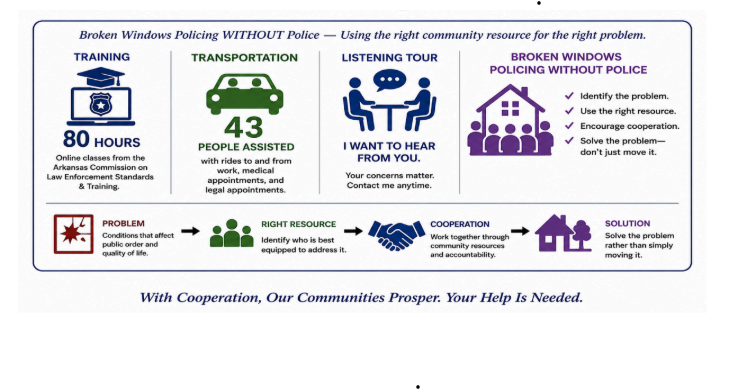
It would be a pleasure to meet with you and hear about the things that concern you. Contact me at any time. I want to hear from you and to help in any way that I can.

Transportation

In June, I was able to assist 30 people to and from work, medical and legal appointments. If you are, or someone you know is, struggling to find transportation please call me at the number below.

Training in Law Enforcement Procedures and Practices

The Arkansas Commission on Law Enforcement Standards & Training provides hundreds of on-line classes on topics related to police authority and operations. I have passed 80 hours of them.

If you have questions or concerns about policing in your community, call me.

Broken Windows Policing WITHOUT Police

With input from voters, taxpayers and public servants, we should begin a conversation about problems that have existed far too long. Some of those problems are less expensive and intrusive, but none of them are easy.

Code Enforcement

Two activities carried out by Code Enforcement strike me as genuinely harmful to both citizens and efforts to create livable communities.

The first involves the codes that dictate the appearance of properties of all kinds in all parts of the city. My concern is with a small subset of residents: those responsible for maintaining properties who lack the financial or physical means to do so. We have to
find a way to help them maintain their property to code without forcing them to choose between life’s necessities and compliance.

Local governments can use their resources to help those with documented needs and can facilitate private efforts to do the same. We often know when a neighbor is struggling and when that struggle is compounded by codes they can’t meet without
significant sacrifice. Individuals, churches, other non profits and government itself can – and should – step in to help those in genuine need.

How we do so should be the only question.

Second, some property owners are victimized by illegal dumpers, only to have the government punish the victim, not the perpetrator.

Vacant lots as well as unused residential and commercial properties can become illegal dump sites. Little to no effort is made to identify or prosecute those responsible, because it is easier to require the property owner to bear the cost of cleaning up the site. Such properties do not have trash service, as it is paid through water bills. Failure to fix the problem will be met with legal action and additional expense.

That is a broken and unjust system. An immediate and simple change would lessen the burden for citizens who are already paying taxes to local governments. Owners of vandalized lots should be able to get trash pickup at the curb. In cases where the illegal dumping requires heavy lifting/hauling, those local governments could provide assistance to the victims.

Homeless Citizens

Years of personal experience and 19 months in office have convinced me that local governments are mishandling problems associated with indigent/homeless citizens in our community.

I intend to reach out to city, county and other levels of government to enforce current laws (or pass new ones) concerning panhandling and sleeping/camping in open spaces. There are safety and security concerns that require attention.

Seeing human beings in conditions that endanger their health and safety without helping is cruel. We all have the right to conduct our lives in a manner of our own choosing, but that right is not absolute. Local codes require our homes, apartments, businesses and other private spaces to meet minimum health and safety standards.

It is unreasonable to criminalize living in a tent on my own lot, but allow others to live in tents – or in open – on public property or while trespassing on private property. Hundreds of charitable organizations provide temporary, transitional and permanent housing assistance to indigents and other homeless. Governments at all levels offer housing assistance. Food assistance abounds in both the public and private sector. Yet we look away as hundreds live in deplorable conditions and beg for their daily sustenance.

We can build communities that meet the needs of all citizens without violating basic human rights or allowing public displays of human degradation. It is time to begin doing so.

With Cooperation, Our Communities Prosper. Your Help Is Needed.

501 204-0425

Frank@FrankGilbert.org


What Are We Doing?

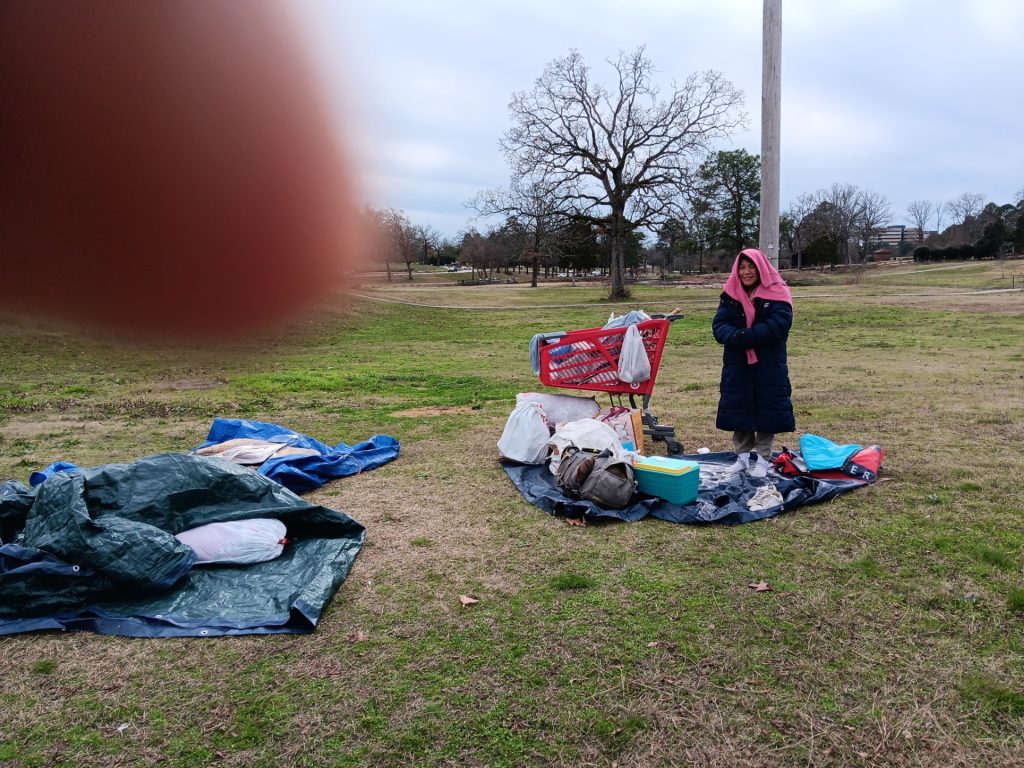
A Lady is living in the open air on the south side of Markham Street, in the park. She is prone on the ground with her belongings in a shopping cart and scattered nearby. She is clearly visible to thousands of people who drive by each day.

I saw her the afternoon of January 9th and parked at the city facilities a couple of hundred yards from her campsite. When I announced myself from about 20 feet away, she rose quickly and easily to her feet and greeted me in English with only a very faint oriental accent. For a few minutes we conversed about the weather before I turned the conversation to my concern. Why did she choose to live outside in the winter?

Her first response seemed to indicate that the Almighty had mandated that she do so. As I explored that with her, it became clear that she had been to court and probably been charged with trespass. Even then, it was not clear whether her aversion to sleeping in a building was mandated by His Honor or the Almighty.

When our conversation turned to the possibility of her going to a women’s shelter it became clear that she did not wish to sleep in any enclosed space. Or maybe I misunderstood her. Perhaps she is not sure why she is where she is.

In any case, she had no interest in seeking shelter in any of the facilities available to indigents, so we talked about her other needs. She is running short of water and would like to have a bottle of Coke. Or
Mountain Dew. She expressed no desire for food. She told me she had no money, but never asked for any.

After that, she shared with me that she had been assaulted recently. She didn’t know why the man attacked her, but was glad that a bystander had reported it and Little Rock Police arrested her assailant. She seemed unconcerned that it might happen again. Since I had neither water nor Coke we parted ways agreeing to pray for each other.

According to a statement made by a city employee at a neighborhood association meeting I attended last year, they do not interfere with folks camping on public property – even sidewalks. It is clear that they have the authority to do so. A recent Supreme Court decision (City of Grants Pass v. Johnson) opened the way for cities to end the practice of public camping.

The city has no obligation to enforce a ban on camping. They seem to think that it is a kindness to allow homeless residents to sleep on the ground in public places. I am convinced that it is not. It is easier than the alternatives, but I believe it is cruel to allow indigents to be exposed to violence and the elements in summer heat and frigid winter weather.

This was Roosevelt Road at Interstate 30 yesterday (1/14/25) on the east side. Folks exiting or entering I-30 West saw this. I passed by it again this morning and it remains a mess. Some of the carts are moved, but it remained an unsightly eyesore.

That exit is a good shortcut to the airport for anyone coming from the north or west. Continuing on the Interstate you have to take the I-530/I-440 exit, then exit again on I 440, take exit 3 and wind your way down Roosevelt from the other side to Airport Road. Only THEN you will intersect Roosevelt again  after it made a much shorter path to that intersection.

Taking Roosevelt will save you miles and give you some up-close-and-personal views of the airport and departing/landing flights. But it will NOT impress visitors to Little Rock.

A few days ago I posted a picture of a young lady living, open-air, in the park on Markham Street. Her plight is heart breaking. She has been physically assaulted living on the streets of our city. She has been hauled into court for a trespass. She isn’t allowed to have a tent (for some unknown reason).

I think most of us see her (and hundreds of others struggling like her) as a sympathetic victim of her condition and circumstances she can’t control. We struggle with her individual rights as a human being and the community standards that most of us have to meet.

There is no doubt that private property looking like the corner of Roosevelt and Interstate 30, or the park where she was living when I talked to her could expect a visit from Code Enforcement.

My first concern is with the individuals who are trapped in circumstances that lead to them living in conditions that are abhorrent. They deserve better and they deserve our respect as we try to make things better for them.

But there are secondary considerations. Equity matters too. When the government applies different standards to different people there has to be a GOOD reason. Public health and safety and community standards should not be applied to homeowners, businesses and some residents and ignored for others.