
 Training
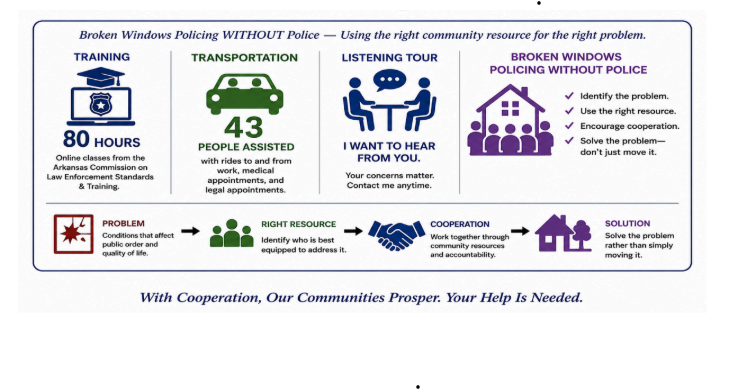
The Arkansas Commission on Law Enforcement Standards & Training provides hundreds of online classes on topics related to police authority and operations. I have completed 80 hours of this training.
Transportation
In August, I was able to assist 43 people with transportation to and from work, medical appointments, and legal appointments. If you are, or someone you know is, struggling to find transportation, please call me at the number below.
Listening Tour
It would be a pleasure to meet with you and hear about the things that concern you. Contact me at any time. I want to hear from you and help in any way that I can. Contact me at the phone or email listed below.
Broken Windows Policing WITHOUT Police
The work of the Homelessness and Indigency Project continues to focus on a simple but important proposition: our communities can address many of the conditions that affect public order and quality of life without relying exclusively on police intervention.
The objective is not to diminish the important role of law enforcement. Rather, it is to identify those problems that can—and should—be addressed through other community resources, cooperation, accountability, and practical problem-solving.
Homelessness and Indigency
Homelessness and indigency remain among the most visible examples of problems that frequently become matters for law enforcement, even though the underlying circumstances are often social, economic, or administrative rather
than criminal.
The Homelessness and Indigency Project is continuing its effort to bring together people who are willing to look beyond simply moving individuals from one location to another and instead examine the conditions that produce recurring problems.
The project is developing an informal network of participants who can contribute different perspectives and resources. The purpose is to encourage cooperation among those already working in this area and to identify practical opportunities where additional cooperation could make a measurable difference.
Code Enforcement and Community Conditions
Adjacent to the Broken Windows concept are conditions in neighborhoods and communities that can deteriorate when they remain unaddressed.
Code-enforcement issues are important in this regard. Abandoned or neglected property, accumulating debris, unsafe conditions, and other visible signs of deterioration can affect an entire neighborhood. Addressing these conditions does not necessarily require punitive code-enforcement actions; in many instances, the appropriate response lies with property owners, community organizations, or other responsible parties.
The goal is to encourage those responsible for these conditions to act before relatively small problems become larger and more expensive community problems.
Cooperation Rather Than Displacement
A recurring theme in this work is the difference between solving a problem and simply moving it somewhere else. Whether the issue involves homelessness, indigency, neglected property, or other quality-of-life concerns, repeatedly relocating the problem does not
constitute a solution. Effective community response requires identifying who is in the best position to address the underlying condition and encouraging cooperation among those parties.
That is the practical meaning of Broken Windows Policing WITHOUT Police: using the right community resource for the right problem whenever that is possible.
Looking Ahead
The work of August reinforces the need for a broader community conversation about how we respond to conditions that affect public order, neighborhood stability, homelessness, and indigency.
The objective is straightforward:
Identify the problem.
Identify who is best equipped to address it.
Encourage cooperation.
Solve the problem rather than simply moving it.
The Homelessness and Indigency Project will continue developing these relationships and looking for practical opportunities to turn cooperation into measurable results.